
Charlotte’s Web
“The least a man can do at such a time is to declare himself and tell where he stands.”


A FEW DAYS AGO, the Department of Homeland Security (DHS) launched a new largescale deportation campaign—this time in Charlotte, North Carolina.
Like other past DHS operations, this operation has been cruel, sloppy, and heavy-handed. DHS agents are smashing car windows, raiding churches, and shutting down schools in their efforts to detain as many brown-skinned people as possible during their time in North Carolina.
And like other DHS operations, DHS gave this operation an unserious, cutesy nickname: Operation Charlotte’s Web.1 The operation’s commander, Greg Bovino, even posted a quote from the children’s book Charlotte’s Web on X, along with a promise that DHS would “hit Charlotte like a storm.”2
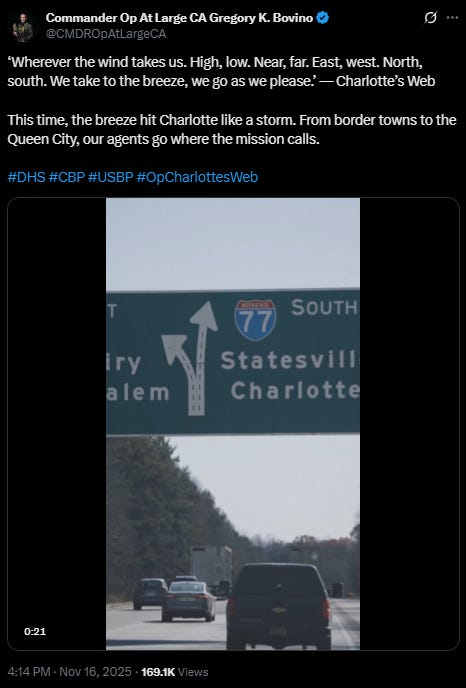
It’s not clear why DHS chose to name this operation after a children’s book. But, in choosing to quote from the book, Bovino seems to be implying that the book fits with, or is somehow supportive of, this administration’s hateful deportation operations.
Nothing could be further from the truth. The author of Charlotte’s Web, E. B. White, would have loathed DHS and the jackbooted thugs it employs.
In 1940, before the U.S. had entered World War II, White published an essay in Harper’s simply titled “Freedom.” It’s worth quoting at length.
I feel sick when I find anyone adjusting his mind to the new tyranny which is succeeding abroad. Because of its fundamental strictures, fascism does not seem to me to admit of any compromise or any rationalization, and I resent the patronizing air of persons who find in my plain belief in freedom a sign of immaturity. If it is boyish to believe that a human being should live free, then I’ll gladly arrest my development and let the rest of the world grow up.
White saw clearly what was happening in Nazi Germany, but he was deeply alarmed by his fellow Americans who would justify, excuse, and defend it: “Where I expected to find indignation, I found paralysis, or a sort of dim acquiescence, as in a child who is duly swallowing a distasteful pill.”
White lamented the pseudo-intellectual types he’d meet in Manhattan, who would trivialize, rationalize, or even express support for rising fascism in Europe.
One man told me that he thought perhaps the Nazi ideal was a sounder ideal than our constitutional system “because have you ever noticed what fine alert young faces the young German soldiers have in the newsreel?” . . . Such a remark leaves me pale and shaken. If it represents the peak of our intelligence, then the steady march of despotism will not receive any considerable setback at our shores. . . .
Another man assured me that anyone who took any kind of government seriously was a gullible fool. . . . He said it didn’t make any difference really about this war. It was just another war. Having relieved himself of this majestic bit of reasoning, he subsided.
Another individual, discovering signs of zeal creeping into my blood, berated me for having lost my detachment, my pure skeptical point of view. He announced that he wasn’t going to be swept away by all this nonsense, but would prefer to remain in the role of innocent bystander, which he said was the duty of any intelligent person. (I noticed, that he phoned later to qualify his remark, as though he had lost some of his innocence in the cab on the way home.)
Those are just a few samples of the sort of talk that seemed to be going round—talk that was full of defeatism and disillusion and sometimes of a too studied innocence. Men are not merely annihilating themselves at a great rate these days, but they are telling one another enormous lies, grandiose fibs. Such remarks as I heard are fearfully disturbing in their cumulative effect.
People today often express the same indignation, disillusionment, and lame excuses that tortured White more than 85 years ago. And when you push back against these sentiments, the conversation often culminates in something along the lines of “Well, what’s the point? What am I supposed to do about it?”

White acknowledged—and I acknowledge as well—that there isn’t much any one person can do. But “[t]he least a man can do at such a time is to declare himself and tell where he stands.”
The least a man can do at such a time is to declare himself and tell where he stands. I believe in freedom with the same burning delight, the same faith, the same intense abandon which attended its birth on this continent more than a century and a half ago. . . . I am in love with freedom and that it is an affair of long standing and that it is a fine state to be in, and that I am deeply suspicious of people who are beginning to adjust to fascism and dictators merely because they are succeeding in war. From such adaptable natures a smell rises. I pinch my nose.
I also think White made clear what he would think of a man like Greg Bovino.
[A] man’s free condition is of two parts: the instinctive freeness he experiences as an animal dweller on a planet, and the practical liberties he enjoys as a privileged member of human society. The latter is, of the two, more generally understood, more widely admired, more violently challenged and discussed. It is the practical and apparent side of freedom. . . .
To be free, in a planetary sense, is to feel that you belong to earth. To be free, in a social sense, is to feel at home in a democratic framework. In Adolph Hitler, although he is a freely flowering individual, we do not detect either type of sensibility. From reading his book I gather that his feeling for earth is not a sense of communion but a driving urge to prevail. His feeling for men is not that they co-exist, but that they are capable of being arranged and standardized by a superior intellect—that their existence suggests not a fulfillment of their personalities but a submersion of their personalities in the common racial destiny.
In Bovino, too, I do not detect either type of sensibility. He does not treat brown-skinned people like people; he treats them as props in a hateful play in which he’s desperate to be the star. He treats brown-skinned people as things that are “capable of being arranged” as he sees fit.
I, like White, will never support men like Trump, Stephen Miller, or Bovino, who so gleefully stamp on “man’s free condition.”
WHITE DIDN’T HAVE A MAGIC ANTIDOTE to the “dim acquiescence” to fascism he saw in his fellow Americans, but he did feel that “[t]he least a man can do at such a time is to declare himself and tell where he stands.”
I feel that’s all I can do. So that’s what I’m doing.
Like White, I stand on the side of freedom, for “I know that the free spirit of man is persistent in nature; it recurs, and has never successfully been wiped out, by fire or flood.” And for that reason I stand firmly against Bovino and this administration’s cruel deportation operations. And if “it is boyish to believe that a human being should live free, then I’ll gladly arrest my development and let the rest of the world grow up.”
Bye.
DHS loves cutesy nicknames: its operation in Chicago was named Operation Midway Blitz; one of its operations in Los Angeles was named Operation Excalibur; and its detention centers often have locale-specific nicknames, like Florida’s Alligator Alcatraz, Nebraska’s Cornhusker Clink, and Indiana’s Speedway Slammer.
For a deeper dive on what a clownish goober Bovino is, check out this article from Jonathan V. Last.